Matter vs Thread vs Zigbee vs Z-Wave: which one do your devices actually use?
Published 10 May 2026
The short version
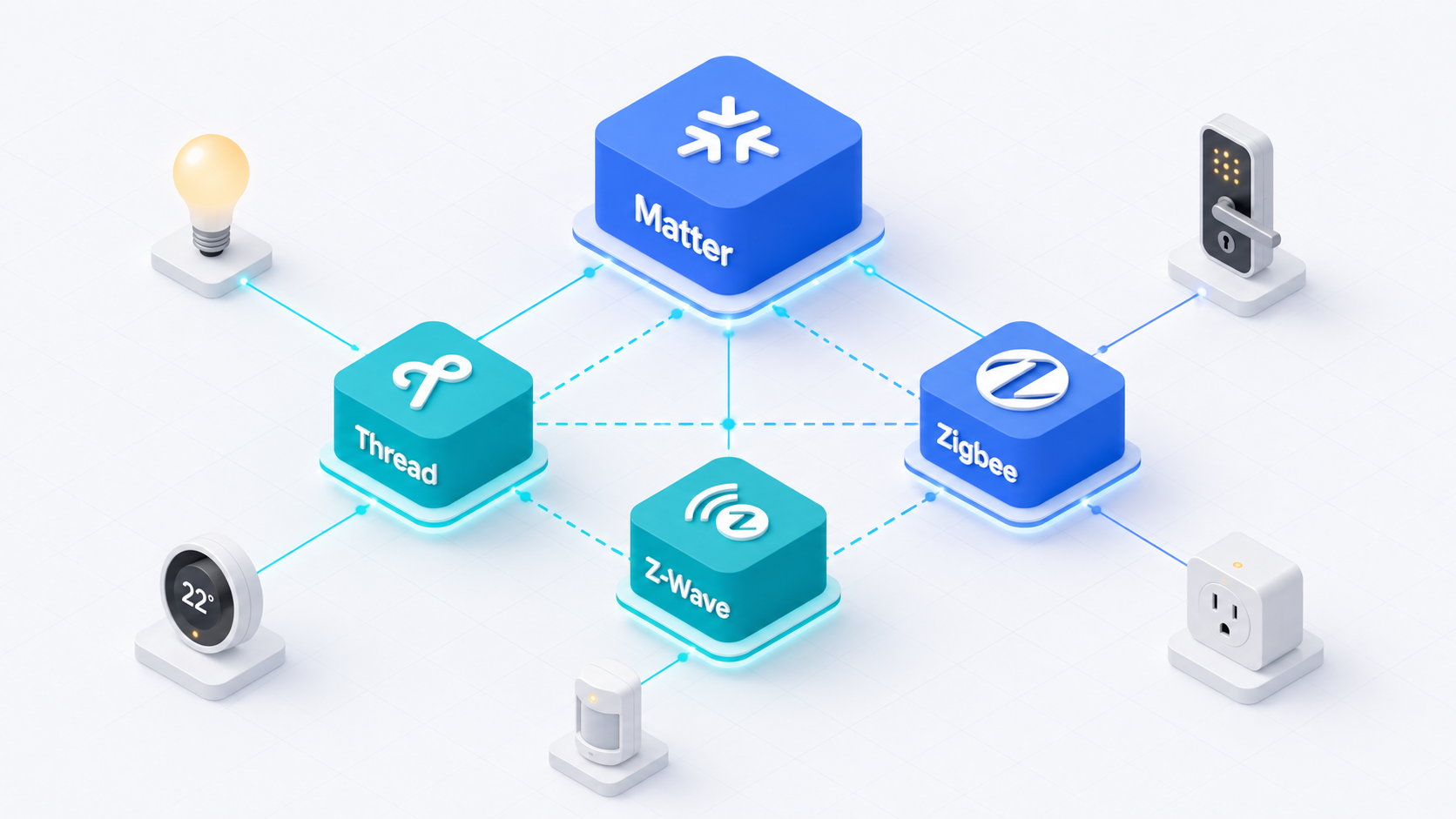
These four names get thrown around as if they were alternatives to each other. They're not. They sit at different layers of the smart home stack, and most modern devices use a combination of them.
StandardWhat it actually isControlled byMatter | An application-layer standard — the "language" devices speak so they can be controlled by any platform (Apple Home, Google Home, Alexa, SmartThings, Home Assistant). | Connectivity Standards Alliance (industry consortium)
Thread | A low-power, mesh radio network — the "road" that small battery devices travel on. Matter runs on top of Thread for sensors, locks, and other low-power gear. | Thread Group (industry consortium)
Zigbee | An older low-power mesh radio network. Pre-dates Matter. Still widely used, but products are increasingly being bridged into Matter rather than spoken to natively. | Connectivity Standards Alliance (same group, different protocol)
Z-Wave | A proprietary low-power mesh radio network. Older, used heavily in North American security and lighting gear. Not part of Matter directly — accessed through hubs. | Z-Wave Alliance
A useful mental model: Matter is the language. Thread, Zigbee, Z-Wave, and Wi-Fi are the roads it (or its predecessors) travels on.
Matter: the language layer
Matter is the part most people care about. It's a 2022 standard backed by Apple, Google, Amazon, Samsung, and roughly 300 other companies. The promise is simple: if a device has the Matter logo, it works with any Matter controller — your iPhone, your Google Nest Hub, your Echo, your Home Assistant install — without needing a brand-specific app or hub.
Matter itself doesn't transmit data. It runs on top of two transport layers:
- Matter over Wi-Fi — for devices that have plenty of power (plugs, light bulbs, cameras, hubs, smart displays)
- Matter over Thread — for devices that need to run on batteries for months or years (sensors, locks, contact sensors, remotes)
There's also Matter over Ethernet (mostly for hubs and bridges) and Matter setup uses Bluetooth Low Energy for the initial pairing, but those two are the headline transports.
When you see a product page that says "Works with Matter, WiFi" — that's Matter over Wi-Fi. When it says "Works with Matter, Thread" — that's Matter over Thread.
Thread: the road for battery devices
Thread is a low-power mesh radio standard, similar in spirit to Zigbee and Z-Wave but newer and built specifically for the smart home era. It was published in 2015 by the Thread Group (Apple, Google, Nest, Samsung, ARM, and others).
Three things to know:
- It's a mesh. Devices route messages for each other. The more Thread devices you have, the more reliable the network gets.
- You need a border router. Thread devices can't talk to your phone directly — they need a bridge to your Wi-Fi network. HomePod mini, HomePod 2, Apple TV 4K (2nd gen+), Nest Hub (2nd gen), Nest Hub Max, Echo (4th gen+), Echo Hub, and most modern smart home hubs are border routers.
- It's battery-friendly. A Thread contact sensor can run for years on a coin cell. A Wi-Fi contact sensor needs a recharge every few weeks.
Thread without Matter exists (it's been around since 2015), but for consumers today, Thread is almost always paired with Matter. If you're buying a Matter-over-Thread device, you need at least one Thread border router in your home for it to work.
Zigbee: the old reliable
Zigbee has been around since 2003. It does roughly the same job as Thread — low-power mesh radio for battery devices — but it's older, more fragmented, and historically required a brand-specific hub (Philips Hue Bridge, Aqara hub, SmartThings hub, Hue Sync Box, etc.).
Zigbee devices are not Matter devices natively. They get into the Matter ecosystem one of two ways:
- Through a Matter bridge. Philips Hue Bridge, Aqara M3 hub, SmartThings hub — these speak Zigbee on one side and Matter on the other, exposing the Zigbee devices to your Matter controllers as if they were Matter devices.
- Through Home Assistant with a Zigbee coordinator stick (Sonoff ZBDongle, ConBee, etc.), which can then re-expose them through HA's Matter bridge.
Zigbee isn't going away anytime soon. Millions of devices are deployed, and Hue, Aqara, and IKEA all still ship new Zigbee gear. But for new purchases in 2026, "native Matter" (over Thread or Wi-Fi) is the cleaner path — fewer hubs, less brand lock-in.
Z-Wave: the North American outlier
Z-Wave is the oldest of the four (2001), proprietary (owned by Silicon Labs until recently), and most common in North American security systems, in-wall switches, and locks. It operates on a different radio frequency than Zigbee/Thread (sub-GHz, around 908 MHz in the US, 868 MHz in Europe), which gives it better range and wall penetration but lower bandwidth.
Z-Wave is not part of Matter. There's no "Matter over Z-Wave." If you have Z-Wave devices, they reach your Matter ecosystem only through a hub that bridges them — typically SmartThings, Hubitat, or Home Assistant with a Z-Wave stick.
For most new buyers, Z-Wave isn't worth specifically seeking out. Existing Z-Wave deployments are worth keeping. New purchases in 2026 — go Matter.
How to tell which one a product uses
When you look at a Matter product listing, the radio layer is usually called out somewhere on the box or product page. Here's the translation:
- "Matter, WiFi" → Matter over Wi-Fi. Needs a Wi-Fi network and a Matter controller. No border router needed.
- "Matter, Thread" → Matter over Thread. Needs a Thread border router (HomePod mini, Apple TV 4K, Nest Hub 2nd gen, Echo 4th gen+, etc.).
- "Matter, WiFi, Bluetooth" → Matter over Wi-Fi, with BLE used only for the initial setup. Normal once it's paired.
- "Zigbee, Works with Matter" → Zigbee device that gets into Matter through a brand hub bridge. You need the brand's hub.
- "Z-Wave, Works with SmartThings" → Z-Wave device. Not directly compatible with Matter. Needs a bridging hub.
On the Products That Matter directory, the radio type is shown on every product card.
A simple decision flowchart
Buying a sensor, contact sensor, motion sensor, button, or door lock? → Look for Matter over Thread. Battery life will be measured in years, not weeks. You'll need a Thread border router.
Buying a plug, light bulb, light strip, switch, smart display, or anything that's permanently powered? → Matter over Wi-Fi is fine. Simpler setup, no border router needed. Battery life is irrelevant.
Buying lights and you already have a Hue Bridge? → Stick with Hue's Zigbee bulbs. The Hue Bridge bridges them into Matter automatically. Don't migrate working hardware.
Already have a SmartThings or Home Assistant setup with Z-Wave gear? → Keep it. Add new devices as Matter where possible. Don't rip out working Z-Wave.
Just starting from scratch with no existing hubs? → Buy Matter-native (Wi-Fi or Thread). Get a HomePod mini or Echo Hub or Nest Hub 2nd gen as your border router. You're set.
Common misconceptions
"Matter replaces Thread." No. Matter runs on Thread. They're complementary.
"I need a Matter hub." Not quite. You need a Matter controller — but that can be a HomePod, Echo, Nest Hub, or even just an iPhone or Android phone in some setups. You don't need to buy a dedicated "Matter hub" the way you needed a Hue Bridge.
"Matter over Thread is faster than Matter over Wi-Fi." Not really. Wi-Fi is much higher bandwidth. Thread's advantage is power consumption, not speed.
"Zigbee is dying." Slowly being eclipsed by Thread/Matter for new products, but the installed base is massive and Hue / Aqara / IKEA are still shipping new Zigbee gear. It'll be around for years.
"Z-Wave is dead." Reduced, not dead. Still common in pro-installed security systems and US in-wall switches. New consumer Z-Wave gear is rare in 2026.
TL;DR
- Matter is the language. Thread, Zigbee, Z-Wave, Wi-Fi are the roads.
- For new purchases, look for Matter over Wi-Fi (powered devices) or Matter over Thread (battery devices).
- Zigbee and Z-Wave are still useful if you already have hubs, but don't seek them out for new setups.
- You need a Matter controller (HomePod, Echo, Nest Hub, phone) and — for Thread devices — a Thread border router (usually the same device).
Browse the complete catalog of Matter-certified products to see exactly which radio type each device uses.